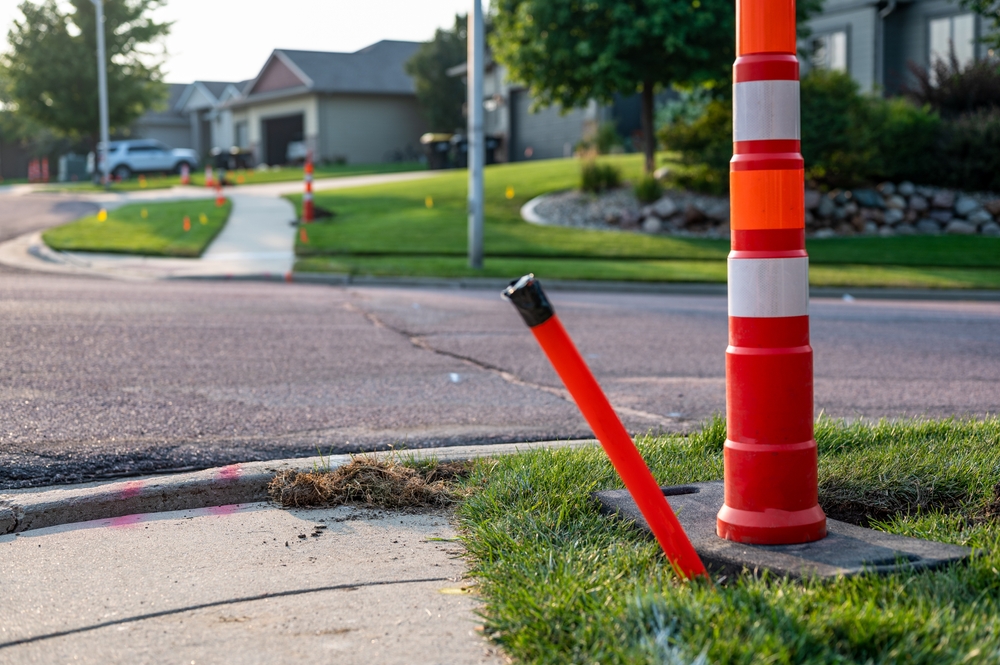
Directional boring (horizontal directional drilling) is typically the better choice for utility crossings under roads and parking lots because it installs conduit, pipe, or cable without disturbing the surface above. Contractors and municipalities should choose directional boring when surface restoration costs, traffic disruption, or pavement warranties make open trenching impractical. Standard trenching or missile boring may still be the right call for short, shallow, or unpaved crossings.
Every utility crossing under a road or parking lot comes with the same underlying question: how do you get a pipe, conduit, or cable from one side to the other without tearing up pavement that someone just paid to install? For contractors, municipalities, and developers working across Maryland, Delaware, Pennsylvania, and Virginia, that question has real financial and logistical weight. Choosing the wrong installation method can mean blown budgets, frustrated property owners, and pavement warranties voided before the ink dries.
At Unlimited Underground, we’ve spent more than two decades answering that question for clients across the Mid-Atlantic. Our crews run directional boring, missile boring, and standard trenching operations using Ditch Witch and Vermeer equipment, so we don’t default to one method because it’s the only tool in the truck. We choose the method that fits the job. Here’s how we make that call, and why directional boring usually wins when roads and parking lots are involved.
What is directional boring, and how does it work under pavement?
Horizontal directional drilling (HDD), commonly called directional boring, uses a guided drill head to bore a path underground along a predetermined route. Instead of cutting a trench from the surface, the drill enters the ground at an angle, travels beneath the obstruction, such as a road, parking lot, or waterway, and surfaces at a predetermined exit point. Once the bore path is established, crews pull back conduit, pipe, or cable through the hole.
The result: a utility crossing installed entirely underground, with no open trench and minimal surface disturbance at the entry and exit points. For a road or parking lot, that means no saw-cutting, no full-depth pavement removal, and no multi-day lane closures while asphalt cures.
Why does surface disruption matter so much for roads and parking lots?
Pavement isn’t cheap, and neither is the disruption caused by tearing it up. A trenched crossing under a road typically requires full excavation, pipe bedding, backfill compaction, and pavement replacement, often followed by a waiting period before the surface can handle normal traffic loads again. For municipalities, that translates to lane closures, detours, and public complaints. For commercial property owners, it means blocked parking spaces, disrupted customer access, and the risk of a freshly paved lot that now has a visible patch running through it.
Directional boring sidesteps most of these problems. Because the bore path runs several feet beneath the surface, the road or lot stays open to traffic throughout the installation. There’s no trench to backfill, no large-scale pavement cut, and no waiting on cure time before the surface returns to full use. For projects where minimizing downtime is a priority, that difference alone often settles the decision.
When does directional boring make the most sense?
Choose directional boring when the crossing runs beneath an active roadway, a paved parking lot, a sidewalk, or any surface where disturbance carries a high cost. It’s also the preferred method when:
- The crossing needs to pass under a surface protected by a pavement warranty or a municipal moratorium on fresh cuts
- Traffic flow must be maintained during installation
- The crossing is long enough that trenching would require extended lane closures
- Existing landscaping, hardscaping, or utilities near the surface make open excavation risky
- The client needs the work completed with minimal visible footprint
We’ve run directional boring crossings for utility providers placing fiber and conduit beneath state highways, for developers tying new commercial sites into existing infrastructure, and for municipalities extending service without reopening roads they resurfaced the year before. In each case, the drill path replaced what would have otherwise been a disruptive, multi-week trenching project.
When is standard trenching or missile boring the better fit instead?
Directional boring isn’t the answer for every crossing. Trenching still makes sense for short runs in unpaved areas, shallow installations where restoration costs are low, or projects where the soil conditions and utility depth make open-cut work faster and more cost-effective than mobilizing a directional drill rig.
Missile boring, which uses a pneumatic hammer to bore a straight, unguided path, is a strong option for short, simple crossings, such as a single driveway or a narrow sidewalk, where precision steering isn’t necessary and the distance doesn’t justify the setup of a full HDD rig. It’s faster to mobilize for small jobs and often more economical when the crossing is short and the path is predictable.
The decision ultimately comes down to three factors: the length and depth of the crossing, the value and sensitivity of the surface above it, and the project timeline. A contractor planning a utility tie-in across an unpaved field has different priorities than a municipality boring beneath a recently repaved four-lane highway. Unlimited Underground evaluates each of these factors before recommending a method, because the right call depends on the specific site, not a one-size-fits-all default.
What should contractors and municipalities evaluate before choosing a method?
Before committing to a crossing method, it helps to walk through a short list of project-specific questions:
- What’s underneath the surface? Existing utilities, soil composition, and groundwater all affect which method is feasible.
- How sensitive is the surface above? A high-traffic road or a newly paved lot raises the cost of disruption significantly.
- What’s the project timeline? Trenching under pavement often takes longer once restoration and cure time are factored in.
- What’s the crossing length? Longer distances favor directional boring; short, simple paths may not need it.
- Are there regulatory or warranty restrictions on cutting the surface? Many municipalities and property owners have strict rules about reopening recently paved areas.
Answering these questions early, ideally with input from an experienced boring contractor, prevents costly surprises mid-project.
Plan your next utility crossing with a Mid-Atlantic trenchless expert
Utility crossings under roads and parking lots don’t have to mean disrupted traffic, torn-up pavement, or blown timelines. With the right method, and the right crew, these installations can go in cleanly, efficiently, and with minimal impact on the surface above.
Unlimited Underground has spent over 20 years delivering directional boring, missile boring, standard trenching, and full utility construction services across Maryland, Delaware, Pennsylvania, and Virginia. With 10 three-man crews and industry-leading Ditch Witch and Vermeer equipment, we have the experience and manpower to handle crossings of any size, from a single driveway bore to a multi-lane highway crossing.
If you’re planning a utility crossing and need a contractor who can recommend the right method for your site, contact Unlimited Underground to discuss your project.